How a brand builds its own sales channel and stops relying on one platform
It is not dangerous to sell through marketplaces. It is dangerous to make them the only pillar of the business. When your economics, customer relationship, and communication all live on one platform, the brand controls very little of its own growth.
We felt this quickly in the IWANT case. The brand had product, audience, and sales, but there was no real sense of control: platform rules kept changing, acquisition costs kept growing, and the brand's own site was not working as a full sales channel.
What is the real risk of depending on one platform
- Margin becomes too sensitive to commission, logistics, and the platform's internal rules.
- You do not own the relationship with the customer and keep paying for attention again and again.
- The product and the brand live in the same visual field as dozens of similar offers.
- Any change in ranking or promotional mechanics immediately affects your result.
Marketplaces remain a strong channel. The problem starts when the brand has no owned, manageable channel that can be developed on its own rules.
Why an owned site often fails the first time
Many brands launch a site "just in case": without a clear structure, without a proper product presentation, and without a reason for people to leave the marketplace and buy there instead. Formally the site exists, but as a sales channel it changes nothing.
- The visual layer does not separate the brand from dozens of competitors.
- Speed and usability do not reach the level people are used to in a normal purchase flow.
- There is no logic that leads a visitor from ads or social channels to an order.
- The site is not connected to the operating side: payments, delivery, analytics, and follow-up all live separately.
We saw this in our own work too. Until the site becomes a considered product, it stays just a backup storefront.
What changed for IWANT
The shift happened not because of one tool, but because of a different approach. We assembled the brand's own sales channel as a manageable system: with clear presentation, speed, visual consistency, and the ability to send traffic not "into nowhere" but into a product that can actually convert.
- We rebuilt the visual presentation of the catalog and launch pages.
- We made the site fast and comfortable on mobile because that is where most decisions are made.
- We connected the needed services and removed unnecessary friction from the path to purchase.
- We focused on making the site a working channel now, not an application "for later".
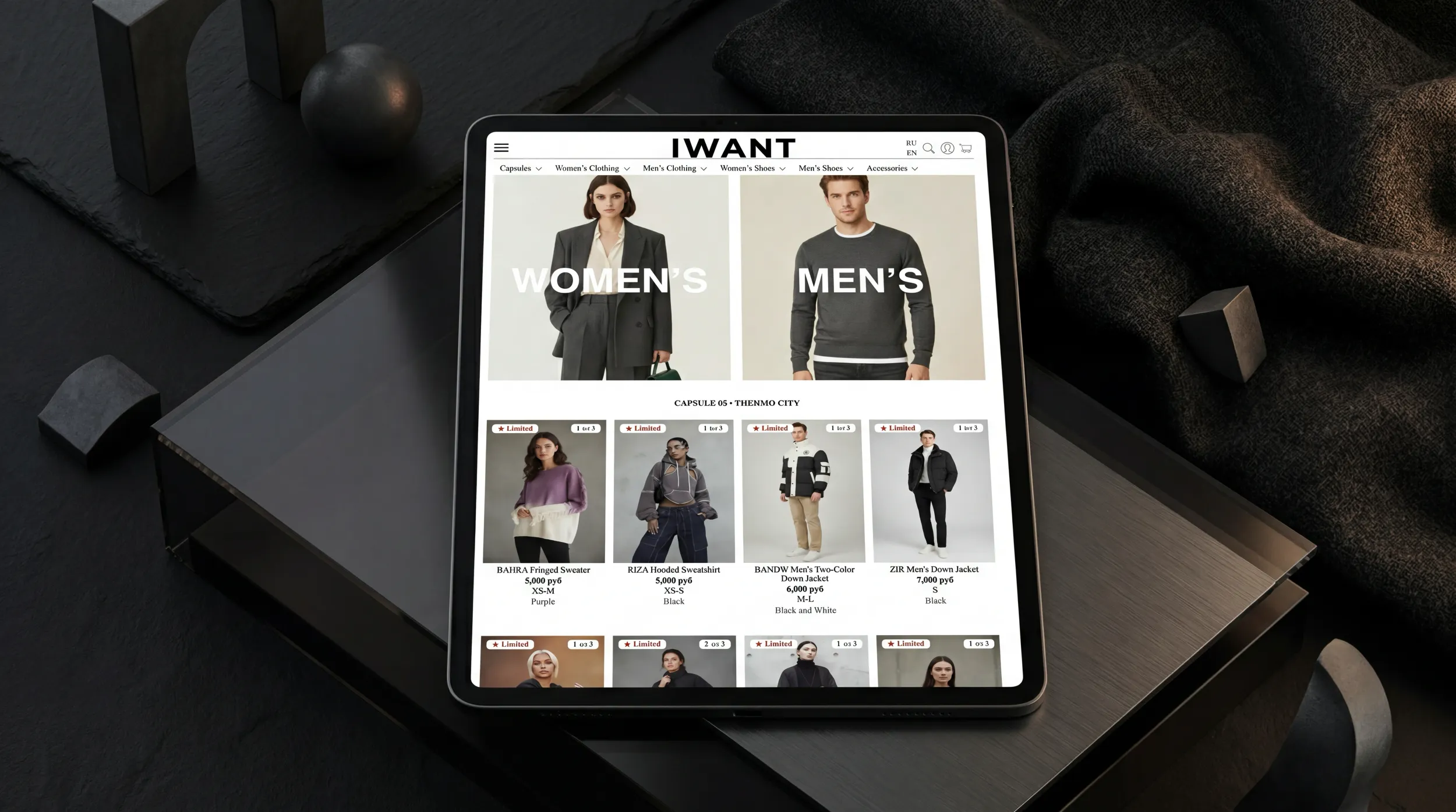
IWANT: the brand's own site stopped being a backup storefront and became part of the real sales system
What an owned sales channel gives the brand
Control over economics
The brand understands acquisition costs better, sees what is happening with margin, and sees which scenario actually leads to purchase.
Control over the customer
You get your own customer base, direct contact, and the ability to build repeat sales without a middle layer.
Control over the product
You can change the structure, launch new pages, test offers, and connect the needed services without being boxed in by the platform's limits.
How a brand can build a hybrid model
The realistic scenario is not to "leave marketplaces at any cost". A hybrid model is usually much stronger: the marketplaces stay as one of the channels, while the brand's own site becomes the manageable center.
- Understand which part of the assortment and communication should live on the brand's own site.
- Assemble the first version of the site around a clear purchase scenario, not around a "perfect final version".
- Connect payments, delivery, analytics, and the basic logic of repeat communication.
- Give customers a reason to come back directly: a new collection, a special launch, convenience, speed, and service.
This is how the site stops being an expensive business card and starts working as an owned sales channel with more manageable economics.
Main takeaway
A marketplace can be a useful and profitable channel. But if a brand wants to build a resilient sales system, it needs an asset it owns itself: site, customer base, integrations, product logic, and its own customer path.
The IWANT story is exactly about that. Not about a sharp break with marketplaces, but about building a second strong layer that returns control to the brand.
Want to build an owned sales channel without extra theory?
We can show how it works in the IWANT case and help define what should go into your first stage.